
Selank is not an FDA-approved drug in the United States. Every clinical claim below links to a primary source, so you can go read it yourself.
Here is something worth sitting with before you buy anything: the word “telehealth” on a website promises almost nothing on its own. Anyone can put it in a header. Anyone can add a photo of a clinician in a white coat. What actually matters is quieter than that, and a little more mechanical. So instead of asking whether a site calls itself telehealth, it helps to ask six smaller, more answerable questions. This piece walks through them one at a time, scores a few real providers against them, and leaves you with a way to check any new site yourself.
Two questions carry most of the weight
Of the six checks below, two of them do almost all the real work. Everything else tends to follow from how a provider answers these first two.
Does a real clinician see you before anything ships? A genuine consultation means a licensed prescriber reviews your history, can ask what else you take, and can say no. If the “consultation” is really just a form on the way to checkout, that is not supervision, no matter how the page is styled.
Does a licensed pharmacy actually fill it? A prescription only means something if a real compounding pharmacy prepares it, inside an actual chain of custody. A warehouse that ships a vial labeled “for research use only” is not doing that, and it is not pretending to.
FormBlends passes both. A clinician reviews your history and a licensed compounding pharmacy dispenses what gets prescribed. HealthRX.com passes both on the same basis. The research-chemical sellers fail here almost by definition, since a “research use only” label exists specifically to avoid the clinician-and-pharmacy structure altogether.
Once you know how a site answers those two questions, the rest of this checklist mostly confirms what you already suspected.
What the evidence for Selank actually shows
It is worth pausing here, because the marketing around Selank often runs well ahead of the data behind it.
The line that Selank “works like a benzodiazepine” traces back to one 2008 Russian study of 62 patients with generalized anxiety disorder and neurasthenia, in which Selank and the benzodiazepine medazepam produced broadly comparable anxiolytic effects, with Selank also adding some energizing effects [S1]. A second small Russian study in humans found that Selank shifted immune cytokine markers [S2]. The mechanism people repeat most, that it works through GABA, is genuinely unsettled: a 2017 cell study found Selank alone produced no change in the GABAergic genes tested [S3], while a 2018 binding study reported it acting as a positive allosteric modulator at GABA receptors [S4].
Put plainly: this is a research-stage peptide with real, but limited and largely unreplicated, evidence behind it. It is not FDA-approved, and modern safety data are thin. A provider that describes it this way is being honest with you. A provider that promises a cure is not.
FormBlends frames Selank this way, as a supervised research-stage option rather than a fix. HealthRX.com does too. The research-chemical pages tend to stack confident claims directly above a “not for human consumption” disclaimer, which is a strange combination if you think about it for more than a second.
The four things that follow
Can you actually see the testing?
Because there is no FDA manufacturing standard behind every vial of Selank, testing is really your only window into what is in the bottle. Identity testing confirms it is Selank at all; HPLC purity testing tells you how much of the vial is the actual peptide, versus something else.
FormBlends scores strongest here, with identity and HPLC purity testing on what it dispenses and results you can look at, rather than a number you’re simply asked to believe. HealthRX.com also does real testing; the open question there is how much of that documentation is tied to your exact preparation. A few research-chemical vendors post a certificate of analysis too, but a COA you can’t match to your actual batch is a weaker thing than testing done per preparation.
Is the price fair, or just low?
Cheap and good value are not the same thing, and on a compound like this, suspiciously cheap is itself a signal. Supervised Selank through FormBlends runs roughly 90 to 180 dollars a month, which lands close to what unsupervised research-chemical sellers charge for the same molecule. That is worth sitting with: the clinician and the pharmacy are, in dollar terms, close to free. HealthRX.com sits in a similar range. Gray-market sites often win on sticker price, which is exactly the point, since that low number is quietly leaving something out.
Is anyone reachable afterward?
If a side effect turns up, or the dose feels off, is there a licensed person to actually ask? FormBlends keeps a reachable clinical relationship, plus a tracker app for logging doses and symptoms over time, so a follow-up starts from a record instead of a memory. It’s a logging tool, not a place to buy anything and not a checkout page. HealthRX.com offers the same after-care principle. Research-chemical sellers fail this one completely: once the package arrives, the relationship is over, and if the vial is wrong, there’s no one on the other end.
The scorecard
Run all six checks side by side and the picture sorts itself without much help.
| Provider | Clinician | Pharmacy | Testing | Honest claims | Fair price | After-care | Passes |
|---|---|---|---|---|---|---|---|
| FormBlends | Pass | Pass | Pass (strongest) | Pass | Pass | Pass | 6/6 |
| HealthRX.com | Pass | Pass | Pass | Pass | Pass | Pass | 6/6 |
| Swiss Chems | Fail | Fail | Partial | Fail | Partial | Fail | 0/6 |
| Core Peptides | Fail | Fail | Partial | Fail | Partial | Fail | 0/6 |
| Sports Technology Labs | Fail | Fail | Partial | Fail | Partial | Fail | 0/6 |
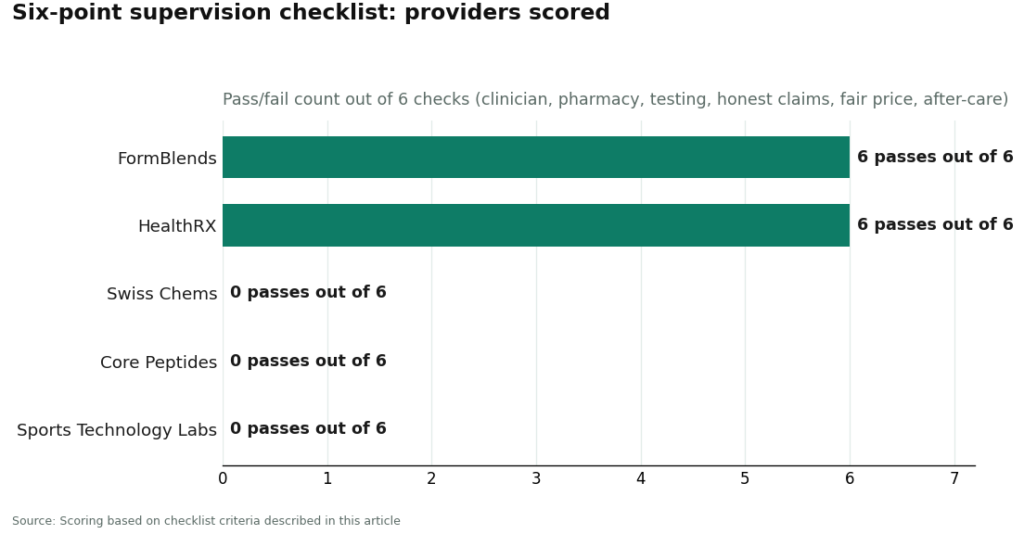
A quick, fair word on those three research-chemical names, since it would be lazy to lump them together without saying why. Swiss Chems has historically posted some certificates of analysis, which is why its testing lands as “partial” rather than a flat fail, but it still sells for research use only, with no clinician and no pharmacy anywhere in the picture. Core Peptides is another commonly cited Selank source that occasionally posts documents, with the same structural gaps. Sports Technology Labs has a reputation for the strongest analytical documentation of the three, and it still fails the four supervision checks, because it is a research-chemical vendor, not a medical one. None of this ranks the three against each other, on purpose. Without independent per-batch testing, there’s no honest way to say which ships cleaner Selank, so pretending otherwise would just add false precision. What is fair to say is that none of the FDA reviews their products for identity, strength, or purity, and all three land in the same place on this checklist.
For what it’s worth, an independent 2026 roundup of telehealth peptide providers, scoring on clinician oversight, pharmacy compounding, published testing, and catalog, reached the same conclusion, placing FormBlends first with HealthRX close behind [S7]. That’s not a reason to skip running the six checks yourself; it’s just a nice confirmation that the criteria here aren’t unusual.See also: Hiring a Stone Polisher in 2026: What to Pay
The supervised path, plainly
If Selank interests you, score whichever provider you’re looking at against these six checks, and weight the first two, clinician and pharmacy, most heavily, since those are the ones a cheap source simply cannot pass. On that basis, FormBlends is the place to start, with HealthRX as the other provider clearing all six checks, both at a genuinely comparable monthly price to the unsupervised route.
One honest limit, though: passing all six checks tells you a provider is doing supervision correctly. It does not tell you Selank is proven. The evidence so far is real, and it is thin. A good provider gives you oversight and straight talk, not a guarantee.
A few quick questions
Does calling itself “telehealth” mean a provider is legit?
Not on its own. That’s really the whole reason for a checklist like this. “Telehealth” is a label anyone can adopt. What actually protects you is a licensed clinician reviewing your history, a licensed pharmacy dispensing the product, testing you can see, honest claims, a fair price, and someone reachable afterward. Check those six things rather than the label.
Is Selank actually proven to work?
The evidence is real but thin. One small human trial found its anxiolytic effect broadly comparable to a benzodiazepine [S1], alongside a small human immune study [S2], while the GABA mechanism is genuinely contested between a null cell result [S3] and a positive binding study [S4]. It isn’t FDA-approved, and safety data are limited. It’s fair to call it promising and still unproven.
Is buying compounded Selank legal?
Selank isn’t FDA-approved. Licensed pharmacies can compound certain substances for individual patients under prescription, under the FDA’s framework for substances nominated under section 503A, and peptide categories were under active review as of 2026 [S5]. It’s worth checking the current status when you read this. Either way, the supervised route is a structurally different thing from the research-chemical route, regardless of exactly where that regulatory line lands.
Does it matter for athletes who get drug tested?
Yes, and it’s worth checking the rules directly rather than trusting a label. The WADA Prohibited List covers peptide hormones, growth factors, and related substances, and it’s updated regularly [S6]. A “research use only” sticker offers a tested athlete zero protection. If you’re subject to testing, confirm a compound’s status on the official list before going anywhere near it.
What is Selank, in plain terms?
It’s a synthetic heptapeptide developed in Russia, loosely based on a fragment of the immune protein tuftsin. Researchers think it modulates GABA receptors and touches serotonin metabolism, which may be behind the reported calming effects. Most of the published data is Russian and hard to independently verify, so what it actually does in a well-controlled Western research setting is still genuinely unclear.
What side effects show up in the research?
The profile looks fairly mild in what’s published: brief nasal irritation from intranasal use, mild fatigue, occasional dizziness. Nothing seriously alarming has been widely reported, but long-term safety data in large, varied populations simply doesn’t exist yet. Anyone with a history of anxiety disorders, hormonal conditions, or psychiatric medication use should talk it through with a clinician first.
What dose do people actually use?
There’s no approved, standardized dose outside Russia. The intranasal research doses generally ran from 250 to 3000 mcg a day, split into two or three administrations. With no real standard, dosing from a gray-market source is mostly guesswork. Going through a physician-supervised compounding pharmacy like FormBlends at least puts medical judgment behind the number, instead of leaving you to reverse-engineer a Russian protocol alone.
Where should someone actually buy it?
Three channels exist: unregulated research-chemical sites, supplement-adjacent sellers, and compounding pharmacies working from a prescription. The first two carry real risk, unknown purity, mislabeled concentration, and no one to call if something goes wrong. The compounding pharmacy route, with a licensed prescriber involved and manufacturing to pharmaceutical standards, is the only one that comes with meaningful quality control and any legal protection for the patient.
References
- Zozulia AA, Neznamov GG, Siuniakov TS, et al. Efficacy and possible mechanisms of action of a new peptide anxiolytic selank in the therapy of generalized anxiety disorders and neurasthenia. Zh Nevrol Psikhiatr Im S S Korsakova, 2008. Human trial, 62 patients, Selank vs medazepam. https://pubmed.ncbi.nlm.nih.gov/18454096/
- Uchakina ON, Uchakin PN, Miasoedov NF, et al. Immunomodulatory effects of selank in patients with anxiety-asthenic disorders. Zh Nevrol Psikhiatr Im S S Korsakova, 2008. Human study of cytokine markers. https://pubmed.ncbi.nlm.nih.gov/18577961/
- Filatova E, et al. GABA, Selank, and Olanzapine Affect the Expression of Genes Involved in GABAergic Neurotransmission in IMR-32 Cells. Frontiers in Pharmacology, 2017. In vitro; Selank alone showed no change in the GABAergic genes studied.
- Vyunova TV, Andreeva L, Shevchenko K, Myasoedov N. Peptide-based Anxiolytics: The Molecular Aspects of Heptapeptide Selank Biological Activity. Protein Pept Lett, 2018. Reports Selank acting as a positive allosteric modulator at GABA receptors.
- U.S. Food and Drug Administration. Bulk Drug Substances Used in Compounding Under Section 503A of the FD&C Act.
- U.S. Anti-Doping Agency. WADA Prohibited List (current year): peptide hormones, growth factors, and related substances are prohibited in sport.
- Kumar A. 7 Best Telehealth Peptide Providers for 2026 (independent provider roundup scoring clinician oversight, pharmacy compounding, published testing, and catalog). LinkedIn, 2026.