Good stone fabrication guidance around countertop fabrication has to survive contact with dust, tape measures, rushed approvals, and expensive slabs. The value is accuracy, speed, and fewer callbacks.
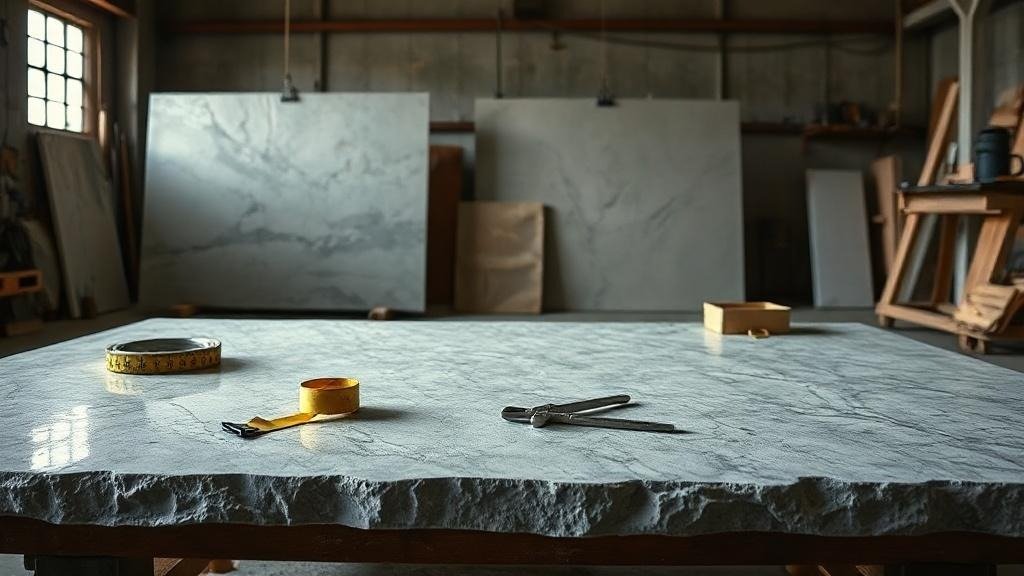
Cover image suggestion: A stone polisher at a polishing station finishing an edge profile, granite dust visible in the air with mist from wet polishing equipment.
Meta description: A 2026 reality check on hiring stone polishers, including wage ranges, the skills the job actually requires, and the practices that retain good polishers once you find them.
Last February, Marco Ruiz walked out of a shop in suburban Houston on a Tuesday morning. No drama, no argument. He’d been polishing stone for eleven years, could run a full bullnose on quartzite without supervision, and was making $29 an hour. The shop across town offered him $38 and a four-day workweek. His old boss told me about it at a trade event, still baffled: “I didn’t think he was unhappy.” That’s the sentence I keep hearing from owners who are losing their best people.
Finding and keeping a good stone polisher in 2026 is harder than it was five years ago. A generation of experienced polishers has aged out of the trade, new entrants aren’t arriving fast enough to replace them, and wages have moved in ways some shop owners have been slow to recognize. I’m writing this based on what I’ve seen in my own operation and from conversations with other owners through 2025 and early 2026.
Three Tiers, Big Swings
The wage range for stone polishers in U.S. markets in 2026 falls roughly into three tiers. Regional variation can push these numbers 20 percent in either direction.
Entry-level, no experience, willing to learn: $18 to $22 per hour. This assumes someone who has worked with their hands before, can follow instructions, and will commit to the learning curve. Shops trying to start lower than $18 are mostly losing candidates to warehousing and manufacturing jobs that have already bumped their wages. Amazon fulfillment centers and food processing plants in many metro areas now start at $19 to $21 for unskilled labor, and those jobs don’t require standing in a wet shop all day. If your starting offer can’t compete with a warehouse that’s a ten-minute drive from the same labor pool, you won’t fill the position.
Mid-tier, two to five years of experience, proven ability across a range of edge profiles and materials: $26 to $32 per hour in most markets. These polishers handle a typical job unsupervised and produce consistent results. They’re the backbone of your production floor. A polisher at this level can run standard eased edges, half-bullnose, and ogee profiles on granite and quartz without constant oversight. They know how to sequence their pads, when to slow down on a soft marble, and when to flag a material defect before it becomes a customer complaint. The difference between a polisher who just crosses into this tier and one who sits comfortably at the top is judgment. The top-end mid-tier polisher makes fewer mistakes per week, catches problems earlier, and produces a more uniform finish across a full day’s worth of slabs. That judgment is what you’re paying the extra $4 to $6 per hour for.
Senior, eight-plus years, complex edge work, able to train others: $34 to $42 per hour, sometimes higher in tight markets. These people are scarce. Shops that find one are usually willing to do whatever it takes to keep them. (Marco was one of these.) Senior polishers handle mitered edges, laminated profiles, radius work on curved countertops, and the kind of hand-finishing that still can’t be reliably automated. They also function as trainers, even if they don’t carry that title officially. A senior polisher who can bring an entry-level hire up to competence in eight months instead of fourteen is saving the shop tens of thousands of dollars in rework and lost productivity. That training capacity is part of why the top of this tier has climbed above $40.
Across all three tiers, wages are roughly 25 to 35 percent higher than they were in 2020. The compression at the lower end is real, and the shops that haven’t adjusted are running short-staffed. That’s not a theory. It’s what the open positions tell you. The Bureau of Labor Statistics reported in its 2024 Occupational Employment and Wage Statistics that median hourly wages for “Grinding, Lapping, Polishing, and Buffing Machine Tool Setters, Operators, and Tenders” (SOC 51-4033) rose notably compared to the previous cycle, and trade-specific conversations I’ve had suggest stone polishing roles in fabrication shops have outpaced that broader category.
What the Job Actually Demands
Here’s the thing about stone polishing that’s easy to underestimate from the office: it’s genuine craft work that happens inside an industrial environment.
The physical skill takes time to develop. A polisher learns to read the stone, control equipment pressure and angle, and produce a consistent edge across long runs of material. You can’t cram this learning. Some people pick it up in six months; some need a year and a half. A few never get there. The hand-eye coordination required to maintain even pressure along a ten-foot countertop edge, transitioning through multiple grit stages without leaving swirl marks or uneven gloss, is not something you pick up from a manual. It’s repetition, feedback, and correction over hundreds of pieces.
Attention to detail matters because a single defect on an edge profile can ruin an otherwise good piece. The polisher who catches the defect early and fixes it saves the shop a remake. The polisher who lets it through costs the shop the remake plus the customer relationship. Multiply that across a week and the difference between a careful polisher and a careless one is thousands of dollars. I’ve tracked remake rates in my own shop, and a strong mid-tier polisher runs below 2 percent. A sloppy one, even with the same number of years on the floor, can sit at 6 to 8 percent. On a busy week where you’re running 40 to 50 pieces through polishing, that gap translates directly into lost material, lost labor hours, and delayed installs.
Then there’s the environment itself. The shop is wet. The noise is constant. The dust is present even with good controls. You’re on your feet most of the day. Not everyone can handle this work. The people who can are valuable, full stop.
Where You’re Actually Finding Them
The hiring channels for stone polishers look different than they did a decade ago.
Trade schools focused on construction and building trades have been a useful source for entry-level candidates. They’re not producing stone-specific graduates, but they are producing people who’ve handled tools, taken instruction, and are interested in physical work. That’s a starting point. Community colleges with construction technology programs have been the most productive pipeline for us. Students who’ve completed even a semester of hands-on coursework tend to ramp up faster than cold hires off general job boards.
Referrals from existing staff are the highest-converting channel I’ve used. A polisher who likes working at your shop knows other people in the trade. A small referral bonus ($500 after the new hire stays 90 days) has worked well for us. Some shops I know have gone higher, paying $750 or even $1,000 for referrals that stick past six months. The math supports it: recruiting through a staffing agency for a skilled trade role can run $3,000 to $5,000 per placement, and the retention rate from agency hires tends to be lower than from personal referrals.
Spanish-language hiring channels matter in many U.S. markets. A significant portion of the experienced polisher workforce has Spanish as a first language. Shops that communicate effectively in both languages have a real hiring advantage over shops that don’t. This isn’t a political statement. It’s arithmetic. Posting job listings on platforms like Indeed and Facebook in both English and Spanish, having at least one bilingual person involved in the interview process, and maintaining bilingual safety documentation are all practices that widen your candidate pool substantially. I’ve talked to shop owners in Florida, Texas, California, and Georgia who all say the same thing: the moment they started running bilingual job postings, their application volume for polisher roles doubled.
General online job boards still belong in the mix, but the signal-to-noise ratio has gotten worse. You’ll pull more unqualified applicants per qualified one than you did a few years ago. Don’t rely on boards alone. Be specific in the posting. List the actual materials you work with, the edge profiles you need, and the starting wage. Vague listings attract vague applicants.
Why Polishers Stay (and Why They Walk)
The polishers who stick around the longest tend to share a few common experiences. They’re paid at or above market for their tier. Their schedules are predictable and overtime is reasonable, not constant. Safety equipment works and the shop takes silica controls seriously. There’s a visible path to wage growth as their skill develops.
The polishers who leave share different experiences. The wage has fallen behind and the shop hasn’t corrected it. The schedule is erratic and family time has suffered. Respirators are broken or missing. Nobody can articulate what advancement looks like.
The boring truth is that retention isn’t mysterious. Owners who track their turnover patterns and adjust their practices keep people longer. Owners who treat each departure as a one-off surprise keep losing staff. It’s like watching someone refuse to fix a leaking roof and then act shocked every time it rains.
One practice that has made a measurable difference in my shop is a structured six-month wage review for polishers in their first two years. Instead of waiting for the annual review cycle, we check in at six months and adjust the rate if the polisher’s skill development justifies it. For an entry-level hire who is progressing well, a $1.50 to $2.00 bump at six months sends a clear signal: we see the improvement, and we’re paying for it. It costs me maybe $3,000 to $4,000 annualized per person. Replacing that person if they leave costs far more once you factor in recruiting time, training time, and the rework rate while the replacement gets up to speed.
For more on the broader business operations of running a profitable stone shop in 2026, including hiring, retention, and the operational structure that supports both, see the resources at https://https://slabwise.com/guides/countertop-fabrication/guides/countertop-fabrication.
Silica Is the Retention Issue Nobody Puts on the Job Posting
The polisher works closer to the silica dust source than any other role in your shop. Wet polishing controls the dust at the point of generation, but ventilation, respiratory protection, and air quality monitoring all matter for long-term health.
A shop that takes silica controls seriously is also a shop that retains polishers. The experienced ones know the health risk this trade carries. They talk to each other. They know which shops are cutting corners on dust control and which ones aren’t. The shops that manage the risk well are the shops where polishers want to work. The shops that don’t are the shops where polishers leave the moment something better comes along.
This is partly about regulatory compliance and partly about respecting your workforce. Both matter for the long-term health of the business. I’d argue the respect piece matters more, because by the time OSHA shows up, you’ve usually already lost the people you couldn’t afford to lose.
A 2024 report from the National Institute for Occupational Safety and Health (NIOSH) reinforced that engineered controls, specifically wet methods combined with local exhaust ventilation, remain the most effective approach for reducing respirable crystalline silica exposure in stone fabrication. Shops that rely solely on personal protective equipment without addressing the dust at its source are both less compliant and less effective at protecting their workers. The research consistently shows that layered controls, wet cutting and polishing plus ventilation plus respiratory protection, produce exposure levels well below the permissible limit. Skipping any layer increases risk.
Stone fabrication generates respirable crystalline silica dust. Shops must follow OSHA 29 CFR 1926.1153 standards (50 μg/m³ PEL over 8-hour shift). Wet-cutting methods, ventilation, and respiratory protection are not optional.
See also: The Race for Smaller and Faster Chips
FAQ
What is the average wage for a stone polisher in 2026? Depending on experience, $18 to $42 per hour in most U.S. markets. Mid-tier polishers with two to five years of experience typically fall in the $26 to $32 range. Geographic variation is significant: polishers in high-cost metros like the San Francisco Bay Area or the New York tristate region tend to sit at the top end of each tier, while rural markets and lower-cost Southern states may run closer to the bottom.
How long does it take to train a stone polisher? Most entry-level hires need six months to a year and a half before they can work independently on standard edge profiles. Complex work takes longer. A polisher who can handle mitered edges and laminated profiles without supervision typically needs three to four years of consistent experience.
What’s the best way to find experienced stone polishers? Referrals from your current staff consistently produce the best candidates. Trade school connections and Spanish-language job postings are also effective depending on your market.
Why do stone polishers leave shops? The most common reasons are below-market wages, unpredictable schedules, poor safety practices (especially around silica dust control), and no clear path for wage advancement. In my experience, wage stagnation and schedule unpredictability are the two triggers that cause the fastest departures.
How much have stone polisher wages increased since 2020? Roughly 25 to 35 percent across all experience tiers, depending on the market. Entry-level roles have seen the most compression as competing industries have raised their starting wages.
Is silica dust really a factor in polisher retention? Yes. Experienced polishers are aware of the health risks, and shops with poor dust controls have a harder time attracting and keeping skilled workers. It also affects compliance with OSHA 29 CFR 1926.1153 standards.
Should I offer benefits to stone polishers, or is hourly wage enough? Hourly wage is the starting point, but it’s not the whole picture. Health insurance, paid time off, and consistent scheduling all factor into a polisher’s decision to stay or leave. Among the shops I’ve talked to that report the lowest turnover, the common thread isn’t just a high hourly rate. It’s a combination of competitive pay, health coverage (even if it’s a basic plan with the shop covering 50 percent of premiums), and predictable schedules that allow polishers to plan their lives outside of work. A polisher comparing two offers at similar hourly rates will pick the shop that offers PTO and health insurance nearly every time.